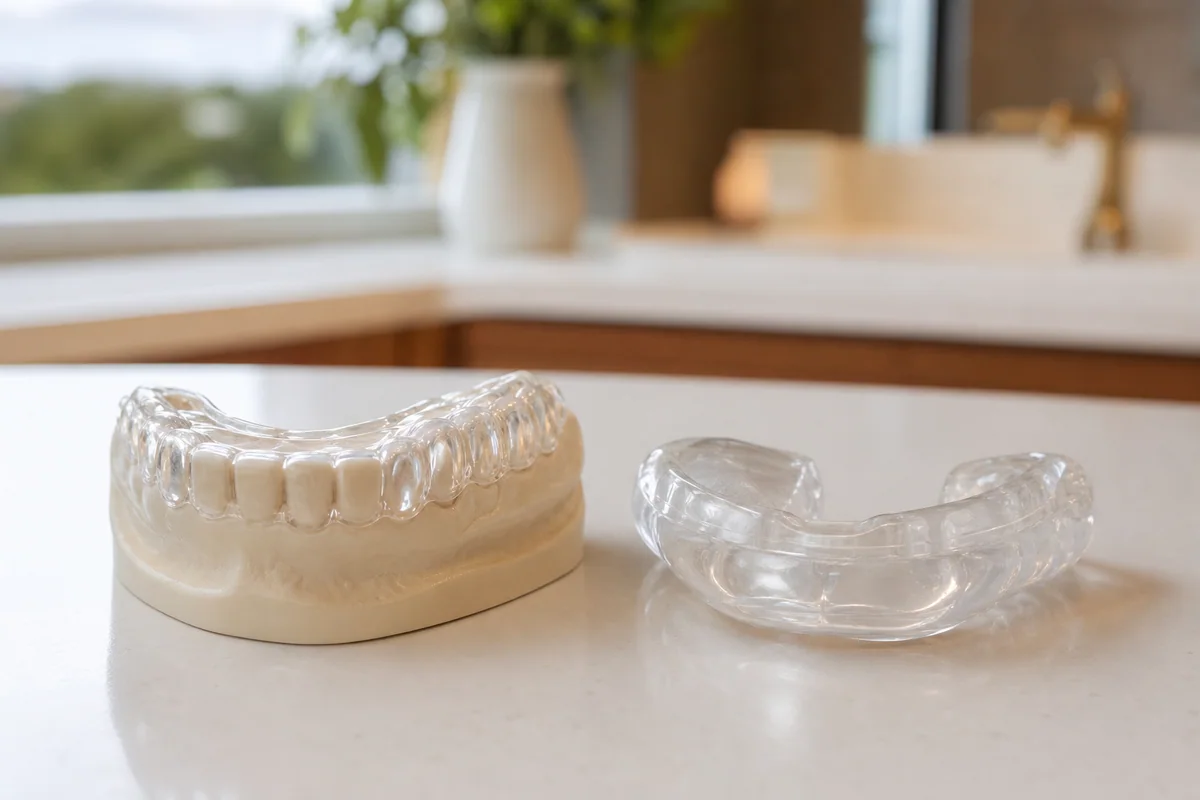
If you grind your teeth at night, you have almost certainly stood in a drugstore aisle looking at a boil-and-bite mouthguard and wondered whether it would do the job for a fraction of the price. It is a completely reasonable question, and the answer is more nuanced than “no.”
Dr. Bridget Woodford and Dr. Alison Allin get asked this regularly, so here is a straight comparison — including where a store-bought guard is genuinely fine and where it can quietly cause problems.
First, Why a Guard at All?
Nighttime grinding and clenching generate far more force than normal chewing, and it happens for hours while you have no awareness of it. Over months and years, that shows up as:
- Flattened, chipped, or visibly worn teeth
- Cracks in enamel and, occasionally, cracked teeth or fractured fillings
- Tooth sensitivity, especially to cold
- Morning jaw soreness and tension headaches
- Receding gums in some cases
A night guard does not stop you from grinding. What it does is put a replaceable layer between your upper and lower teeth, so the guard absorbs the wear instead of your enamel. That is a meaningful distinction — the goal is protection, not a cure.
Where Drugstore Guards Fall Short
Boil-and-bite guards are made from a soft or semi-soft thermoplastic you soften in hot water and bite into. That gives you a rough impression of your teeth, and for some people it is enough to get through a few weeks.
The problems tend to be these:
Fit is approximate. A guard molded in your kitchen sink cannot match the accuracy of one made from a precise impression or digital scan of your teeth. Loose guards shift at night, and many people wake up with them out of place — or find them on the floor.
They are usually bulky. More material means more likelihood you take it out in your sleep without remembering. A guard in a nightstand drawer protects nothing.
Soft material can encourage more chewing. This is the part most people don’t expect. Some patients unconsciously chew on a soft guard, which can increase muscle activity rather than calm it. If you are dealing with jaw pain rather than just tooth wear, that can work against you.
They can shift your bite over time. A guard that only covers some teeth, or covers them unevenly, can allow small tooth movements over months of nightly use. Correcting that costs far more than the guard saved.
They wear out fast. Expect a few months, sometimes less, before it is chewed through.
What a Custom Guard Gives You
A custom night guard starts with an accurate impression or scan of your teeth and is fabricated to fit only your mouth. In practice that means:
- A precise, stable fit that stays put through the night
- Thinner, less intrusive material — which makes it far more likely you actually wear it
- Even contact across all teeth, so your bite isn’t being nudged in one direction
- Material chosen for your situation — a heavy grinder needs something different from someone with mild wear
- Much longer life, often several years with reasonable care
- A bite you can adjust. We can refine the fit at a follow-up visit, which is impossible with a store-bought guard
We also check the guard at your regular visits and look at the wear pattern on it. That pattern tells us how hard you are grinding and whether anything is changing — useful information we would not otherwise have.
The Cost Question, Honestly
A custom guard costs substantially more up front. That is real, and we are not going to pretend otherwise. Two things are worth weighing against it.
First, longevity: a custom guard lasting several years often works out closer in cost per year than the price tags suggest. Second, and more importantly, the cost of what you are protecting. Restoring several worn or cracked teeth with crowns runs into thousands of dollars. A guard is the inexpensive option in that comparison.
Many dental plans contribute toward a night guard when grinding is documented. Our team is glad to check your coverage before you commit to anything.
When a Store-Bought Guard Is Reasonable
We would rather be useful than dogmatic. A drugstore guard makes sense as a short-term stopgap — if you have just noticed grinding and cannot get in for a couple of weeks, wearing something is better than wearing nothing. It is also a fair way to find out whether you can tolerate sleeping with a guard at all before investing in one.
What we would not recommend is using one as a permanent solution, particularly if you are already seeing tooth wear or dealing with jaw pain. At that point the guard is only part of the picture, and we should be looking at the whole thing — which is what our TMJ and TMD care is for.
Let’s Take a Look
If you suspect you grind — or your partner has told you so — a short exam tells us a lot. We can see wear patterns on your teeth that you cannot see yourself, and from there we can give you a straight recommendation rather than a guess.
Patients from Chagrin Falls, Bainbridge, Auburn, Solon, Twinsburg, Aurora, and Moreland Hills have trusted Integrity Dental Group for more than 50 years. Our approach hasn’t changed: quality dentistry, gentle care, and no rushing.
Call us at (440) 708-0900 or visit our office at 16716 Chillicothe Rd #700 in Chagrin Falls. We are open Monday through Thursday and would be glad to talk it through.
Ready to Schedule Your Visit?
The team at Integrity Dental Group is here to help. Call us at (440) 708-0900 or book online.
Book an Appointment