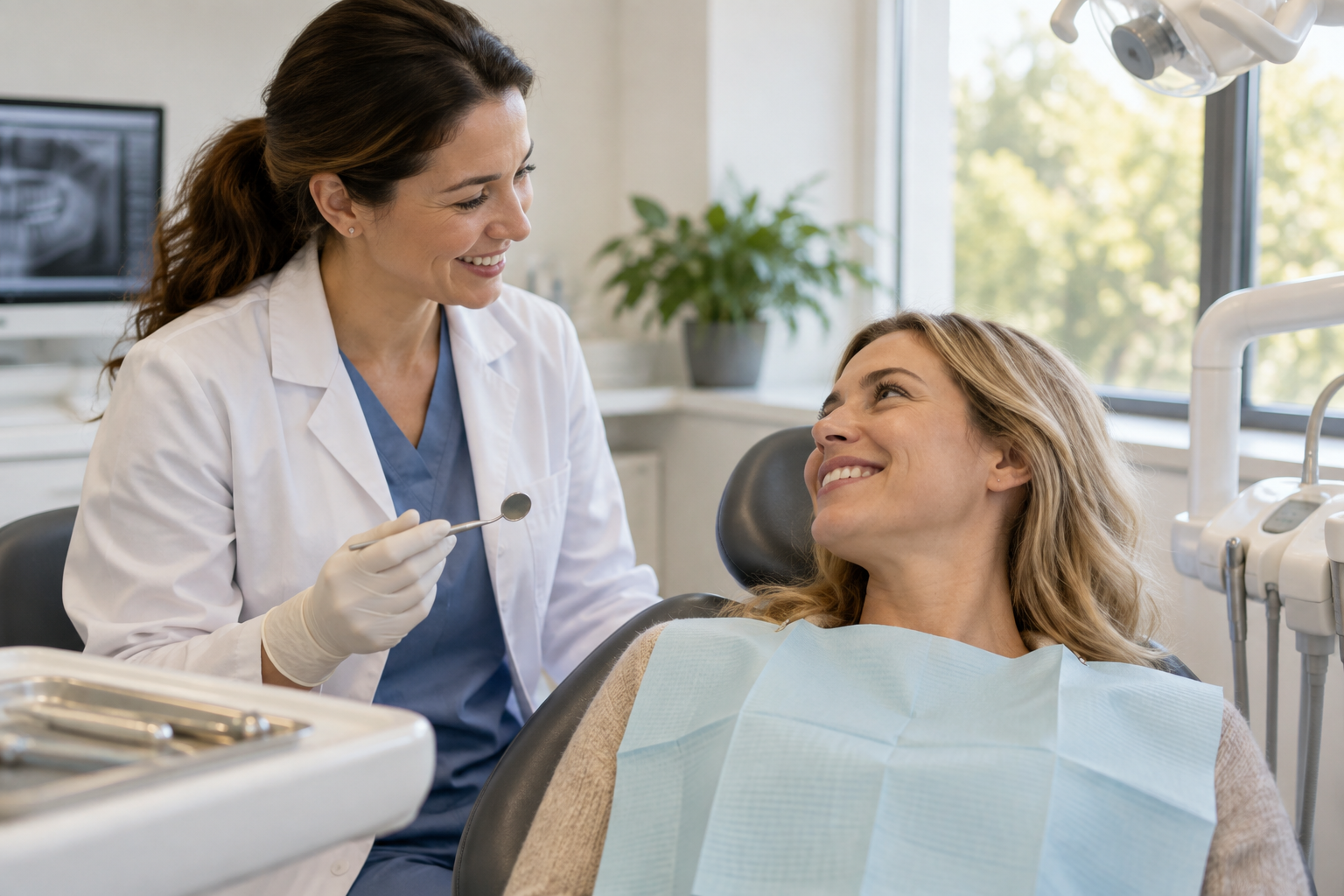
You yawn, and there it is — a click. You take a bite of a sandwich and feel a soft pop just in front of your ear. Maybe it has been happening for years, or maybe it started last month and now you cannot stop thinking about it.
Jaw clicking is one of the most common things patients mention almost as an afterthought at our Chagrin Falls office — usually at the end of a cleaning, usually with an apology for bringing it up. Please bring it up. Dr. Bridget Woodford and Dr. Alison Allin hear this question every week from patients across Chagrin Falls, Bainbridge, Auburn, Solon, Twinsburg, Aurora, and Moreland Hills, and the answer is genuinely reassuring more often than not.
What Is Actually Making the Sound
Your jaw joint — the temporomandibular joint, or TMJ — sits just in front of each ear and is one of the busiest joints in your body, opening and closing thousands of times a day as you talk, chew, yawn, and swallow.
Inside each joint is a small cushion of cartilage, a disc that glides along with the jaw. When that disc slips slightly out of its normal path and then snaps back into place, you hear and feel a click.
A few things can nudge the disc off track:
- Muscle tension from clenching or grinding. Overworked jaw muscles pull the joint out of its easy rhythm — often overnight, without you knowing.
- A bite that does not meet evenly. If your teeth guide your jaw into a slightly off position, the joint compensates.
- Past injury. A sports impact, a fall, or a long dental or medical procedure with the mouth held open can strain the joint.
- Joint wear or arthritis. More common as we get older, and usually gradual.
- Everyday habits. Chewing gum all day, nail biting, resting a phone against your jaw, or chewing ice.
When Jaw Clicking Is Not a Problem
This is the part most patients are relieved to hear: a click by itself, with no pain and no limits on how you open, is very common and often needs no treatment at all. Plenty of people click for decades without trouble.
If the sound is your only symptom, we will note it in your chart, check how the joint moves and how your teeth wear, and then keep an eye on it at your regular visits. No treatment, no pressure. We are not going to talk you into something you do not need — that has never been how this practice works.
When to Have It Looked At
Some signals do deserve a closer look. Call us if the clicking comes with any of these:
- Pain in the joint, the ear, the temple, or the muscles along your cheek
- Locking — your jaw catches when opening, or you cannot close it smoothly
- Limited opening, or a sense that the jaw is drifting to one side
- Morning headaches or jaw soreness, which often point to nighttime grinding
- A new or suddenly louder grinding, gravelly, or crunching sound
- Ringing ears or facial fatigue by the end of the day
Those symptoms suggest the joint and its muscles are working harder than they should, and that tends to be much easier to settle early than after years of strain. You can read more about how we approach the joint itself on our TMJ and TMD treatment page.
How We Evaluate a Clicking Jaw
An evaluation with Dr. Woodford or Dr. Allin is calm and hands-on, and nothing about it hurts.
- We listen to your story. When it started, what makes it worse, how you sleep, how stressed the last few months have been — often the most useful information we get.
- We feel and listen to the joint as you open, close, and move side to side, and check how far you can comfortably open.
- We check your muscles for tender spots along the jaw, temples, and neck.
- We look at your teeth for flattened edges, small chips, or notches at the gumline — the fingerprints of grinding.
- We take images if needed to see the joint and rule out other causes.
Then we tell you plainly which group you are in: nothing to do, some simple home changes, or a treatment worth considering.
What Treatment Usually Looks Like
When treatment is warranted, we start with the gentlest, most reversible options — always.
- Habit and self-care changes. Softer foods for a few weeks, no gum, moist heat on the muscles, and gentle stretches we will show you. This alone resolves a surprising number of cases.
- A custom night guard. If grinding is driving the tension, a guard made from impressions of your own teeth takes the load off the joint while you sleep. It fits and protects in a way a drugstore boil-and-bite version cannot.
- Bite adjustment. Sometimes reshaping a high spot on a tooth, or restoring a worn one, lets the jaw close evenly again.
- Botox for jaw muscles. For patients whose clenching muscles stay locked tight, small therapeutic doses can quiet them down. It is a treatment we offer here, and we are happy to explain whether you are a good candidate.
- Referral when appropriate. If the joint needs specialized care beyond what dentistry addresses, we will say so and help you get to the right person.
A Few Things That Help Starting Tonight
- Rest your tongue lightly behind your upper front teeth with your teeth apart — that is your jaw’s neutral position
- Cut your food into smaller pieces instead of taking big bites
- Skip gum, ice, and chewy candy for a couple of weeks and see what changes
- Notice whether you clench at your desk, in traffic, or while scrolling
- Warm compress for ten minutes in the evening on the sore side
Bring It Up at Your Next Visit
Our team has cared for families in this community for more than 50 years, and questions like this one are exactly what your checkup is for. Whether the answer turns out to be “that is completely normal” or “let’s do something about it,” you will leave knowing where you stand.
Call our Chagrin Falls office at (440) 708-0900 to schedule with Dr. Woodford or Dr. Allin. We are open Monday through Thursday, 9:00 AM to 5:00 PM, at 16716 Chillicothe Rd #700 — no rush, no lecture, just a careful look and a clear answer.
Ready to Schedule Your Visit?
The team at Integrity Dental Group is here to help. Call us at (440) 708-0900 or book online.
Book an Appointment